
Springfield Township Previous Residents by Era
One Springfield Township address can leave several kinds of evidence, but each kind answers a different question. The Lucas County Auditor's AREIS gives a current parcel anchor and historical-transfer-card leads. The Recorder's instruments establish a chain of ownership. Local directories identify people listed at an address in a particular edition. Census, obituary, and probate evidence can then help distinguish an owner from a household member. Treat each record as dated evidence, not a permanent statement about who lived there.
| Trail source | Years available | Local access | Address-history value |
|---|---|---|---|
| AREIS parcel and transfer material | Current tax year with historical functions | Lucas County Auditor | Parcel, owner of record, transfer leads, and historic-card references |
| Recorder deed and instrument system | Online documents from 1985 | Recorder Public Access and counter | Grantor, grantee, document dates, and legal-description chain |
| Historic transfer cards and Auditor images | Transfer cards before 2000; images 1937-1965 | AREIS and TLCPL/Ohio Memory | Older transfer and property-condition leads |
| Toledo City Directories | 1858-present | TLCPL Local History & Genealogy | Names, businesses, and address sections from 1910 forward |
| Toledo Suburban Directories | 1957-present | TLCPL Local History & Genealogy | Township and suburban household leads |
| Sanborn maps and Auditor photographs | 1882-1962 where mapped; 1937-1965 photos | TLCPL and Ohio Memory | Building, street, and property context rather than an occupant list |
For recent previous residents, begin at the current parcel and work backward one transfer at a time. For an older Springfield Township household, begin with the closest directory year and check the parcel, map, and obituary trail around it. The table's years describe collection coverage, not a guarantee that every address appears in every source.
Springfield Township Previous Resident Cards
AREIS is more than an owner-name screen. Township zoning guidance identifies its property owner, parcel number, zoning district, sales, taxes, structure photo, building-sketch, and historic-transfer-card material. For previous residents research, save the parcel and assessor numbers first. They are steadier anchors than a street number when an old directory uses a different mailing identity. The pre-2000 historic transfer cards are especially useful when a modern parcel result gives a transfer clue that needs to be carried into the Recorder's index.
A TLCPL house-history guide brings those sources together with Recorder documents, directories, obituaries, maps, and Auditor photographs. It is a practical local route for documenting a former household without treating any one property screen as a full roster. Record the displayed field labels and date of access because tax data and transfer material may change as the county updates its system.
The library's house-history guide is the source for this Springfield Township previous residents research image. Open the guide and its address-research resources before comparing a parcel with older local collections.
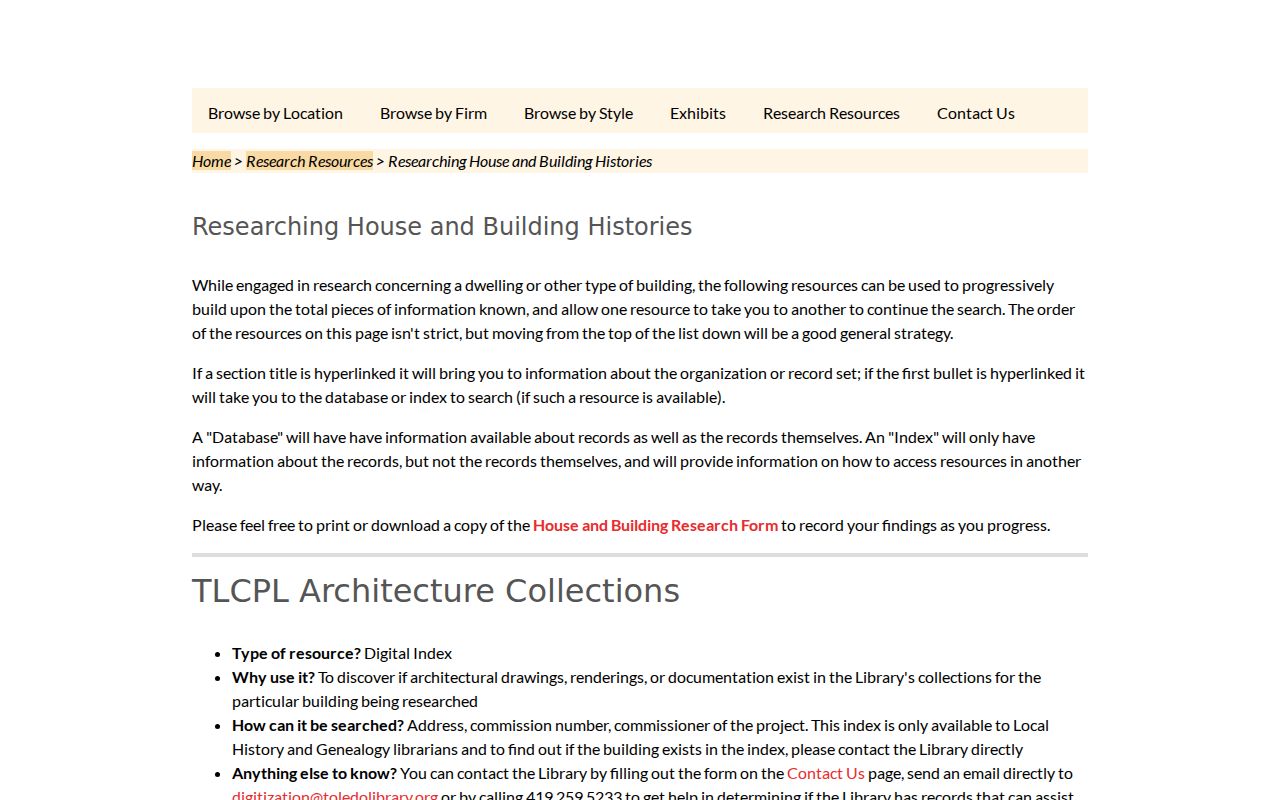
The guide shows why an address trail can move among deeds, photographs, directory entries, maps, and obituaries instead of stopping at a single owner result.
Note: A mailing address or owner label on a property card can be a useful lead, but it does not prove a complete household lived at the parcel.
Springfield Township Previous Deed Records
The Lucas County Recorder Public Access portal reports documents online from 1985 and plats from 1815. That split matters. A document search that ends in 1985 has reached the online boundary, not necessarily the end of the property's history. For an earlier deed or instrument, take the legal description, lot and block, party names, date range, and any book, page, or document reference to the Recorder counter. The Recorder can direct a request toward the older index, deed books, or microfilm path that fits the record series.
The Recorder's public-record policy allows a requester to ask without giving a reason or Ohio residency. It also permits staff to help narrow an ambiguous request. Ordinary counter copies cost $2 per page, a copy fee that is separate from document-recording fees. When a prior owner is known, an exact bounded request is more useful than asking for every record tied to a common surname.
Recorder checkpoint. Online land documents begin in 1985, but plats reach 1815. Keep the legal description with each deed so the counter search can continue before the online date.
Trace Springfield Township Previous Residents
A chain of title is the sequence of recorded transfers for the same parcel. It is an ownership trail, not an automatic list of everyone who lived in the house. Start from an AREIS parcel card, then use the latest transfer and the Recorder's name and instrument search to find the recorded deed. The seller on one transfer often becomes the buyer, or grantee, on the prior transfer. Check the legal description on every link before deciding that two records concern the same Springfield Township property.
- Search the current delivery address in AREIS and record the parcel number, current owner of record, transfer clue, and legal description.
- Locate the latest deed or transfer reference in Recorder Public Access by party name and a bounded date range.
- Read the grantor, or seller, and search that party as grantee, or buyer, to locate the earlier acquisition.
- Repeat the transfer loop while comparing lot, block, subdivision, and legal-description wording at each step.
- When the online record trail reaches its limit, ask the Recorder for the appropriate older index, microfilm, or deed-book route.
- Grantor
- The party transferring an interest in a recorded instrument, commonly the seller in a deed.
- Grantee
- The party receiving an interest in a recorded instrument, commonly the buyer in a deed.
- Chain of title
- A documented sequence of transfers for the same parcel or legal description.
- Legal description
- The lot, block, subdivision, metes-and-bounds, or other land description used to keep the property trail together when an address changes.
Street numbers and mailing names can change while a lot, block, subdivision, or other legal description persists. That is why a Springfield Township deed search should preserve the property description beside every party-name result.
Springfield Township Previous Search Names
Older Springfield Township research has a geography trap. The local historical account says Springfield formed from Waynesfield Township in 1836, added area in 1839, lost territory associated with Monclova in 1853, and lost additional area when Adams Township formed in 1856. A person indexed as Springfield in 1850 may therefore appear under Waynesfield or Monclova by 1860. The same history uses Springfield, Drakes, Hardy, and Holland Station as place labels. Search each relevant locality name beside the street, map clue, or legal description.
The Holland-Springfield-Spencer Historical Society supplies a local place-and-family context, though its web material is not a complete searchable catalog. A bounded request with name variants, an approximate range, and a place label is more likely to reach useful material than a broad request for all information about a family.
The historical society's Springfield-area material is shown in this image. Use the society's public history route to preserve the older locality terms in a house-history search.
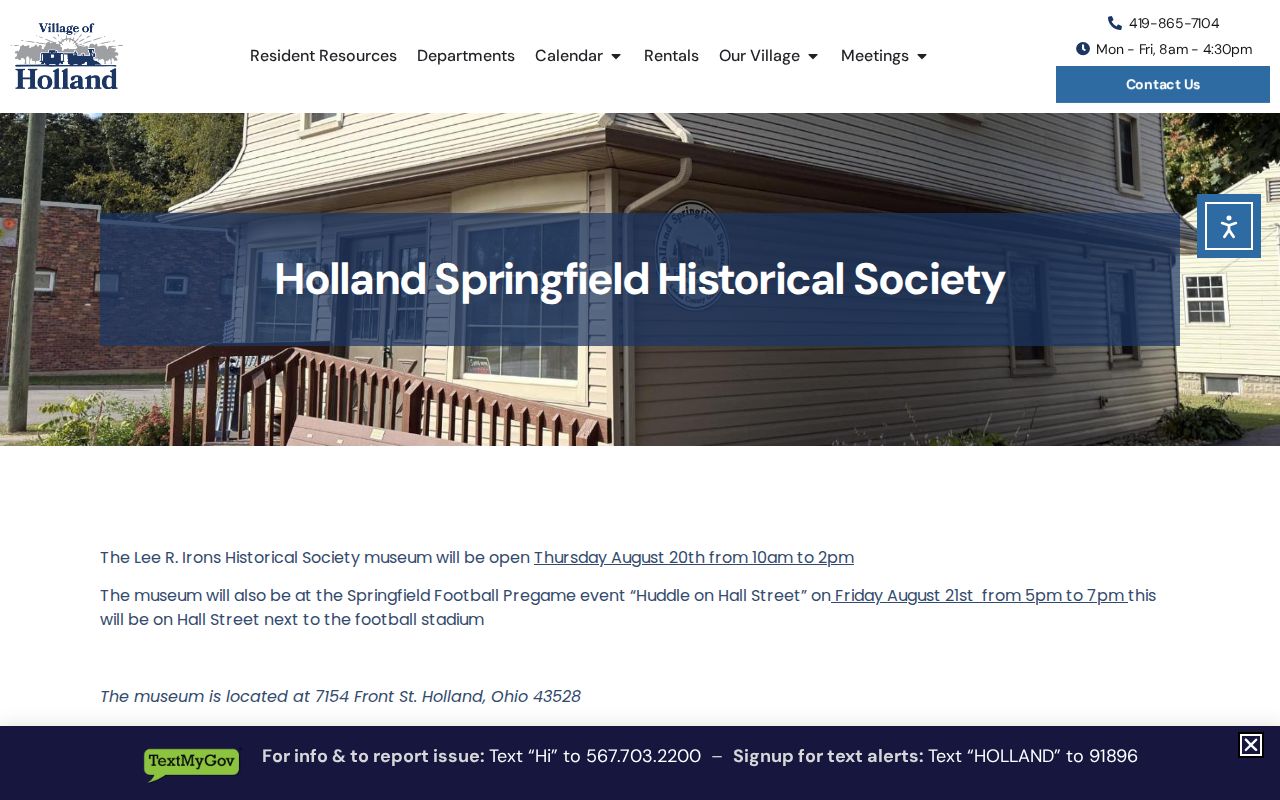
Historic place names can explain an apparent gap between a directory entry and a modern township search, especially when a boundary or station label changed.
Springfield Township Past Households
Ownership is only one layer in a Springfield Township past-household search. TLCPL holds Toledo City Directories on microfilm for 1858-1935 and in books from 1936 to the present. Its guide says street and address sections appear from 1910 forward. Toledo Suburban Directories run from 1957 to the present and can be a better starting point for township-era work. Before treating a missing listing as a negative result, ask the Local History & Genealogy desk whether that edition covers the particular township area or mailing identity.
The address sections, book listings, and digitized examples are described on the Springfield Township city directory page. Use them here as dated household evidence. Record the edition, page, spelling, street number, and any notation, then compare adjacent editions. A spouse name, widow notation, altered number, or changed spelling can separate a move from a different person with a similar name.
- Choose a directory edition near the transfer or photo date and capture the street-number listing and surname entry.
- Check an adjacent edition for continuity, moves, changed numbering, or a different household.
- Pair the time band with the available federal census, which TLCPL's HeritageQuest route lists from 1790 through 1940.
- Use the obituary index, death material, and Probate Court case search as corroborating tracks after a candidate appears.
The Ohio History Connection's death-index route is shown below. Search the historical death collection when a dated directory or property lead points to a possible death record.
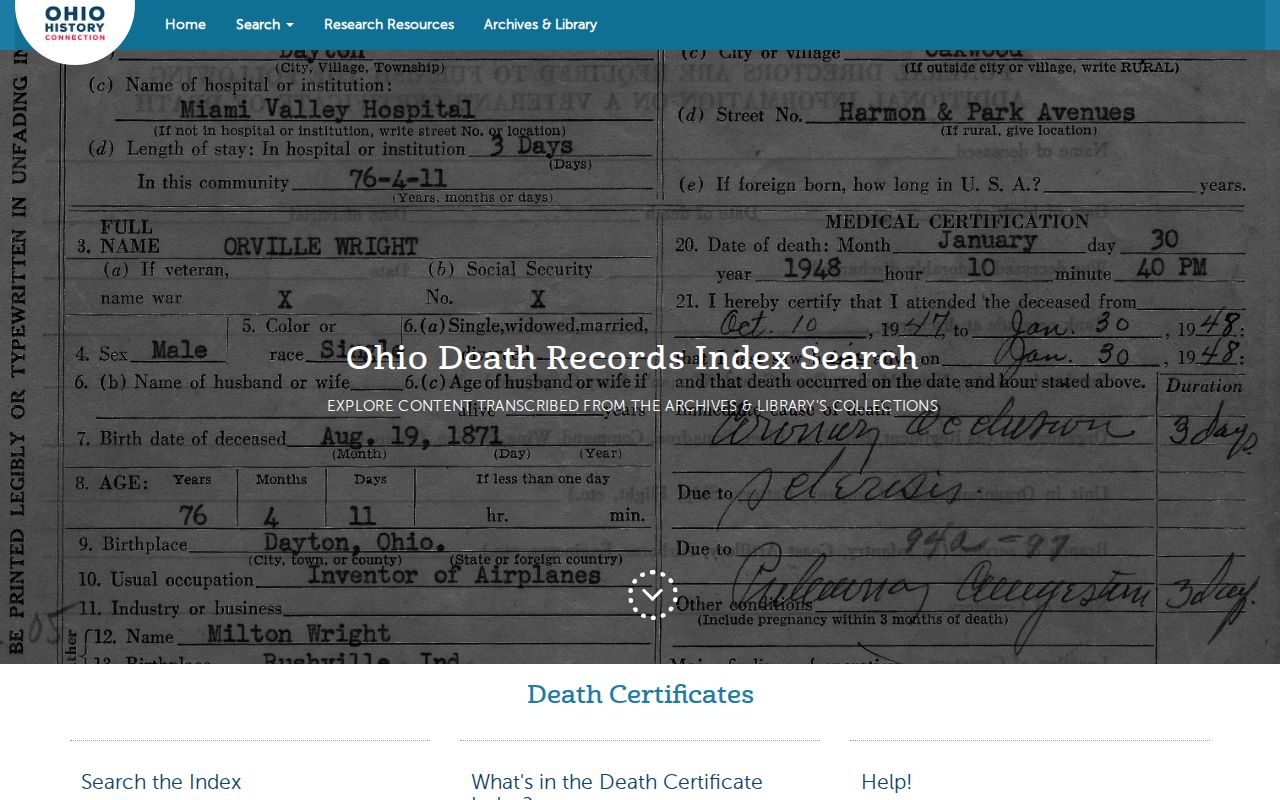
A death-index match is a research lead, not proof of a relationship or a final address. Reconcile it with the recorded deed sequence, obituary issue, and probate information.
Lawful use. Springfield Township past-resident research is suited to house history, family history, and estate questions. Do not use public records to watch, threaten, harass, or expose a living person; Ohio law sets limits on that conduct.
Springfield Township Previous Residents Visuals
Visual records can date a property without identifying its occupants. TLCPL's house-history resources point to Auditor assessment photographs and block cards from about 1937 through 1965. Sanborn maps are available for 1882 through 1962 where mapped, and the Vintage Aerial Library edition provides later neighborhood context. Compare the map edition, photo era, street number, and parcel description before connecting a structure to a particular former household.
A building may change while the address stays the same. Conversely, an old street address may not translate neatly to a modern delivery number. The map, plat, and legal description are the checks that keep a Springfield Township previous residents search from treating visual context as occupancy proof.
Note: Sanborn, aerial, and assessment materials describe property context. Pair them with dated directory or deed evidence before placing a household at an address.
Springfield Township Previous Permit Files
When the deed and directory trail leaves a gap, request the correct property file by parcel rather than surname. Lucas County Building Regulations has residential jurisdiction in Springfield Township, but the research found no public address-history database. Its residential route identifies zoning approval, water and sewer approval, legal description, site plan, construction documents, and application components. For historic files, provide the project address, parcel, date range, and project type when contacting the department.
Township Planning and Zoning is a separate source. Its certificate material distinguishes subdivision, plat, lot, parcel address, assessor number, zoning district, owner or agent contact, and detailed work data. A permit or zoning file may establish project timing or property context. It should not be used to assume a resident list. The best offline packet includes the current and historic street names, parcel and assessor numbers, legal description, party-name variants, bounded dates, and any instrument or book reference already found.
Springfield Township also posts a Planning and Zoning route for its local records and AREIS guidance. That is the right starting point for a township-held request after the parcel has been identified.